 Nov
NovPhnom Penh real estate by district
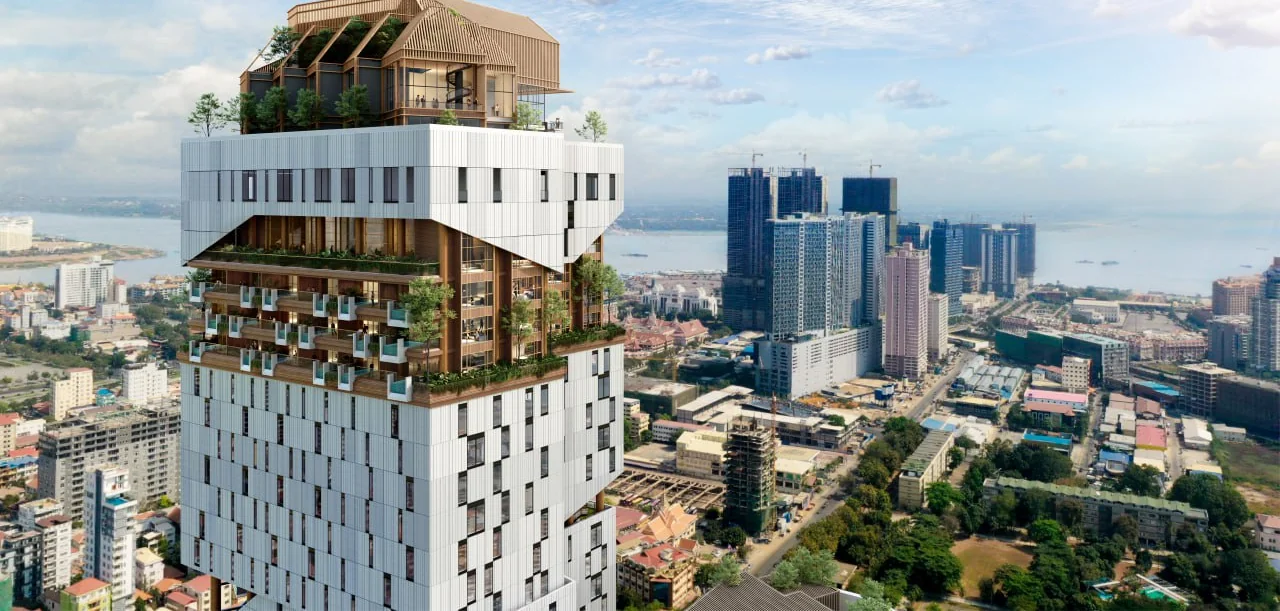
Phnom Penh is one of the fastest-changing cities in Southeast Asia: in a decade Cambodia's capital has gained business districts, high-rises and a stable class of expat tenants. For an investor the real question isn't whether to buy, but where exactly: the district sets the rent, the liquidity and the growth potential. Below is a map of the market by district, with real price benchmarks as of mid-2026.
Projects in Phnom Penh
The catalogue currently has 252 projects for this city area. All 252 projects in the catalogue →
 renderRender: developer/project materials
 renderRender: developer/project materials
 renderRender: developer/project materials
 renderRender: developer/project materials
 Photo: developer/project materials
 renderRender: G.A.T.O Tower project page on IPS Cambodia
G.A.T.O Tower
Choose the daily routine first
Begin with two or three journeys that will be repeated: work, school, healthcare, family, airport or business travel. Then decide what matters most — walkability, parking, quiet streets, a larger development, central access or extra time for bridges and arterial roads.
Only then compare addresses. In Phnom Penh, one street may have a practical entrance and working drainage while the next has noise, construction and a difficult turn. The district and market label help with orientation, but they cannot replace the coordinates, permanent entrance and a timed journey.
Districts and micro-locations by use case
Central living usually leads to a comparison of BKK1, parts of Chamkarmon, Tonle Bassac and Daun Penh. A household with a fixed school run may find Toul Kork or a quieter central street more practical. Buyers looking for a larger newer development should screen Koh Pich, Chroy Changvar and the 60M Road corridor separately.
This is not a ranking. Each option works for a particular routine and carries a different compromise: evening noise, dependence on a car, bridge or U-turn, neighbouring construction, a thinner completed-resale market or the operating cost of a large complex. Use the area guide to test those conditions, or open the district comparison.
BKK1
The "golden square" · premium · from ~$100,000
Business and diplomatic core: embassies, international company offices, schools. The most expensive and stable rent in the city. Home to the premium Odom Tower and Time Square 9 projects.
BKK1 breakdown →Chamkarmon
Balance of price and demand · from ~$40,000
The large district around BKK1: "already near the centre, prices still reasonable." This is where new housing is concentrated — for example Kingston Royale in Toul Tom Poung. An entry point with a minimal budget.
Chamkarmon breakdown →Daun Penh
Historic centre · riverside
Colonial architecture, the Royal Palace, the Sisowath riverside. Strong tourist flow and short-term rent, but little new stock with direct ownership (strata title) available to foreigners.
Daun Penh breakdown →Toul Kork
Respectable north · family rental
Green, quiet residential district with international schools. Demand is family long-term rental, prices below BKK1. An option for a stable rental income.
Toul Kork breakdown →Chroy Changvar
Peninsula · a bet on the future
A peninsula across the river from the centre, with new master plans and a developing riverfront. A bet on the district's growth: a longer horizon and higher upside — along with the risk of early entry.
Chroy Changvar breakdown →Separate zones inside the city
The five districts above are not the whole map of the capital. Some Phnom Penh zones have pages of their own: the sangkat of Tonle Bassac in Chamkarmon and Koh Pich, the island that sits inside it; BKK3, the sangkat next to BKK1; and the 60M Road corridor in Mean Chey. The full list, including the cities outside the capital, is in the Cambodia locations index.
District summary
A quick comparison to get your bearings before moving to each district's detailed breakdown:
| District | Character | For the investor |
|---|---|---|
| BKK1 | Business and diplomatic core | Premium, status, liquidity; budget from ~$100,000 |
| Chamkarmon | New housing "near the centre" | Low entry from ~$40,000, rental income, district growth |
| Daun Penh | Historic centre, riverside | Tourist rental, little new strata-title stock |
| Toul Kork | Respectable residential north | Family long-term rental, prices below BKK1 |
| Chroy Changvar | Peninsula, new master plans | A bet on future development — longer horizon, higher risk |
What things cost in Phnom Penh: general benchmarks
So the figures on the district pages read in context, here are the anchor benchmarks for the capital's market as of mid-2026:
Price per square metre only works with the same denominator
Knight Frank reported an average advertised price of US$676 per sq m of net saleable area for new launches in H2 2025. That figure is not directly comparable with a completed central-city project: the sample, development stage, market class and area definition may all differ. A low citywide launch average can describe a more affordable segment rather than a discount on a like-for-like apartment.
Ask each seller to state in writing the total contract price, internal usable area, balcony area and the area expected to appear on the individual strata title. Recalculate every option using the same area basis and then add mandatory furniture, premiums and fees. Otherwise, the apparently cheaper price per square metre may come from a different denominator rather than a better deal.
Price per square metre only works with the same denominator
Knight Frank reported an average advertised price of US$676 per sq m of net saleable area for new launches in H2 2025. That figure is not directly comparable with a completed central-city project: the sample, development stage, market class and area definition may all differ. A low citywide launch average can describe a more affordable segment rather than a discount on a like-for-like apartment.
Ask each seller to state in writing the total contract price, internal usable area, balcony area and the area expected to appear on the individual strata title. Recalculate every option using the same area basis and then add mandatory furniture, premiums and fees. Otherwise, the apparently cheaper price per square metre may come from a different denominator rather than a better deal.
- New-build price — roughly from $1,700 per sqm in completed residential complexes; premium in BKK1 is noticeably higher.
- Entry point — a one-bedroom apartment in a good complex from ~$40,000; premium BKK1 units from $100,000 and up.
- Rent — a market benchmark of 6–10% per year in dollars (not a guarantee, depends on district and unit).
- Ownership — direct (strata title / freehold) for foreigners, with a quota of up to 70% of the floor area in a building.
- Settlement — in US dollars: Cambodia's economy is effectively dollarised.
Not sure which district fits your goal? Tell us your budget and objective — I'll send a shortlist of units in the right districts with a yield calculation.
First decide why you want property in Phnom Penh
The same district can be a good place to live and a weak fit for a particular investment model. So the choice is best started not with a render, and not even with the price per square metre, but with the scenario in which the unit will actually be used.
Measure the handover wave, not just today's rent
Knight Frank's Cambodia Real Estate Highlights H2 2025 (knightfrank.com.kh, H2 2025) estimated Phnom Penh's existing condominium stock at 63,334 units, 9.6% more than a year earlier. Chamkarmon accounted for 21% of that stock, Sen Sok for 18%, Chroy Changvar and Meanchey for 14% each, and Toul Kork and Boeung Keng Kang for 9% each. These are research estimates rather than a government register, so use them to understand where competition is concentrated, not as an exact count of every building.
Before buying, obtain a list of projects under construction or recently handed over within the unit's realistic competitive area. Compare delivery timing, the number of similar layouts, actual occupancy in completed phases and how many units a single owner or operator may release at once. A large simultaneous handover can raise vacancy and put pressure on achievable rent even in a well-established district.
| Your goal | What to check first | Which districts to look at initially |
|---|---|---|
| Living there yourself | daily routes, noise, sun, parking, shops, healthcare, quality of building management | BKK1, Chamkar Mon, Toul Kork — depending on lifestyle and budget |
| Renting to a professional or a couple | commute to offices, compact layout, workspace, furniture, internet, rental management | BKK1 and the central parts of Chamkar Mon |
| Renting to a family long term | route to school and work, 2–3 bedrooms, storage, kitchen, parking, generator, facilities for children | Toul Kork and quiet residential micro-locations |
| Short-term rental | tourist demand, building rules, operating costs, cleaning, check-in, seasonality | selected buildings in Daun Penh; not the whole district automatically |
| Capital growth | entry price, the real stage of infrastructure, future supply, holding period, exit plan | Chroy Changvar and other developing locations — with extra caution |
| Flexibility on resale | clear title, a liquid layout, a competitive price, building quality and actual demand | established central districts; BKK1 is often in the first circle |
This list does not name a "best district" — it helps you build a shortlist, which is then tested at the level of the specific street, building and unit.
District and micro-location are not the same thing
Two apartments of the same size in the same district can differ in rental appeal and cost of ownership. The reason is usually not the district name but details you only notice on site. Before buying, compare:
- the real route, not the straight-line distance — how long the trip takes in the morning, in the evening and in the rain;
- the last 200–500 metres — the quality of the access road, lighting, pavement, whether you can get a taxi, how safe the entrance feels at night;
- noise at different hours — traffic, bars, construction, schools, plant equipment on neighbouring buildings;
- the orientation of the apartment — direct sun, heat on the facade, the view and the chance of construction opposite;
- engineering reliability — back-up power, water, lifts, ventilation, drainage, fire exits;
- how the management company works — repair response times, the state of common areas, rental rules, transparency of the service charge;
- competition inside the building — how many similar apartments are listed for rent and for sale at the same time;
- the neighbouring plots — what is already built, what is permitted, and whether a new project could block the view or change traffic.
A practical test: visit the address at least twice — on a weekday at rush hour and in the evening. For a rental unit, walk the same route your prospective tenant will use: from home to the office, the school, the supermarket or the riverside.
The new airport changes the route, not the investment case by itself
Techo International Airport officially opened on 9 September 2025 south of Phnom Penh in Kandal Province (OCIC, ocic.com.kh, 9 September 2025). For a buyer, this changes the real journey to the terminal. Door-to-door travel time from the actual building, including bridges, junctions and congestion, matters more than a straight-line distance on a sales map.
Cambodia's Ministry of Public Works and Transport said in April 2025 that a rail connection between Phnom Penh and the airport was still under discussion (MPWT, mpwt.gov.kh, 21 April 2025). Until a line is operating, do not price it into rent, resale value or liquidity. Test the road journey at the times relevant flights normally arrive or depart and check a viable alternative road route as well.
A completed apartment or buying off-plan
Choosing between a finished unit and off-plan is not only a question of discount — these are different sets of risks and different moments when income begins.
A completed apartment. It lets you check what a render doesn't show: finish quality, noise, the view, how the lifts work, the actual common areas, the size of the service charge and tenant demand. Income can start earlier, but the entry price often already reflects that the project is finished. If the seller refers to a rental history, ask for signed contracts rather than screenshots of listings — plus vacancy periods, discounts, utility bills, the management fee and repair costs.
A unit under construction. It may come with an instalment plan and a wider choice of layouts, but the buyer takes on the risk of delay, changes to the specification, build quality and future competition when keys are handed over en masse. There is no yield before completion unless the contract expressly provides otherwise.
Before reserving off-plan, check: who owns the land plot and who is the party to the SPA; whether the recipient of payments matches the contracting party; construction permits and the permitted use of the building; the exact description of the unit, its area, floor and specification; the payment schedule and the consequences of late payment on both sides; the completion date, the grace period and the buyer's protection in case of a long delay; the right to assign before handover and the fee for it; acceptance criteria and the procedure for fixing defects; when and on what terms the individual strata title is issued; what exactly GRR or buy-back mean in the contract. More detail: how to read an SPA in Cambodia.
Count the all-in cost, not just the advertised price
The unit price is only the start of the calculation. To compare two apartments fairly, use the all-in acquisition cost: the sum needed to end up with a legally registered unit that is ready to use. It can include:
- the contract price and premiums for floor, view or specification;
- furniture, appliances and preparing the unit for rent;
- legal review, document translation and a power of attorney;
- registration, tax and banking costs;
- the agent's or management company's fee, if not included;
- the service charge and the initial contribution to the building's sinking fund;
- insurance, utility connections and small repairs;
- a reserve for vacancy and unforeseen costs after handover;
- the cost of financing and currency conversion, if applicable.
Tax rules and incentives can change — confirm current rates as of the transaction date: taxes and costs when buying property in Cambodia.
Gross and net yield: what's the difference
Advertising usually shows gross yield. It is useful for a first comparison, but it doesn't answer the question of how much money the owner actually keeps.
Serviced apartments are a separate rental competitor
Knight Frank's H2 2025 review estimated about 9,096 serviced-apartment units in Phnom Penh, with 93% of the stock in the city centre. Boeung Keng Kang accounted for 31%, Daun Penh for 24% and Chamkarmon for 20%. This inventory competes for professionals, corporate occupiers and mobile tenants who value flexible terms, housekeeping, reception and bundled services.
Knight Frank recorded approximately 39% occupancy and an average rent of about US$18 per sq m per month in the International Class segment during H2 2025. Those figures cannot be applied to an individual condominium, but they show why a rental study should include more than nearby condo listings. Compare the tenant's full monthly cost, lease length, deposit, housekeeping, internet, utilities and early-exit flexibility, then identify why the apartment would still win without a discount that breaks the return model.
Gross yield (benchmark): 12 × the stated monthly rent ÷ the all-in acquisition cost × 100%.
Net cash yield (benchmark): (rent actually received − vacancy − management − service charge − repairs − insurance − applicable taxes) ÷ capital invested × 100%.
An illustrative example, not a forecast. An apartment costs $100,000; furniture and a reserve bring the all-in cost to $108,000; the stated rent is $800 a month.
- The gross calculation with 12 paid months: $9,600 ÷ $108,000 ≈ 8.9%.
- With 11 paid months, revenue is $8,800.
- After a notional $880 for management and $1,200 for service charge, repairs and preparation, $6,720 remains.
- Net cash yield: $6,720 ÷ $108,000 ≈ 6.2% before individual taxes and the cost of financing.
The real outcome can be higher or lower. You cannot compare one project's "8% net under contract" with another's "8% gross on market rent" without going through the terms. More detail: the cost of keeping an apartment in Phnom Penh and investment models in Cambodian real estate.
What a foreign buyer should check before a non-refundable payment
The words freehold and strata title in a presentation are no substitute for checking the documents. For a specific unit it matters that it legally belongs to the private part of a co-owned building, sits on a floor where foreign ownership is permitted, falls within the available foreign quota, and will be able to receive an individual title after registration. The minimum set of questions:
- who is the registered owner of the land and the building;
- whether the seller has the right to contract for this particular unit;
- what title exists now and what document the buyer receives after the deal;
- whether the land, the project or the unit is mortgaged and what consents will be needed;
- whether the foreign quota is available for the chosen apartment, not just "for the project overall";
- whether the unit number, floor, area and boundaries match across all documents;
- who pays taxes, registration, translation and other fees;
- whether you may let the unit out the way you intend and whether the building rules restrict it;
- what happens in case of construction delay, a material change to the project or a refusal to register;
- how disputes are resolved and which law governs the contract.
How the law applies in practice to a specific purchase should be confirmed by an independent local lawyer. Useful reading: can a foreigner buy property in Cambodia.
Apartment and building viewing checklist
In the apartment: the actual usable area and whether the layout makes sense; natural light, heat, ventilation and smells; noise with the windows closed and open; water pressure, drainage, air conditioning and electrics; the condition of windows, waterproofing, kitchen and bathrooms; space for storage, a washing machine and a desk; mobile signal and internet quality; the view today and possible construction tomorrow.
In the building: the number of lifts relative to the number of apartments; back-up power and what it covers; fire stairs, alarms and emergency access; parking, the drop-off point and deliveries; the actual condition of the pool, gym and common areas; the service charge, owner arrears and the reserve fund; rules on renovation, pets, guests and short-term rental; the share of empty apartments and the number of competing listings; the quality of security and the work of the management team.
How to check liquidity before buying
Liquidity is not a property of a district in itself, but the probability of selling a specific unit within a reasonable time without an excessive discount. Before buying, ask yourself: who will be the next buyer of this apartment, and why would they choose it over dozens of alternatives?
Drainage risk belongs to the address, not the district label
JICA's Phnom Penh drainage study divides the capital into 25 catchments and assesses channels, pumping stations, regulation ponds and local topography. The master plan used a five-year return period for drainage design; that does not mean every address within one district has equal protection (JICA Final Report, December 2016).
For a completed building, ask management for the history of flooding at the entrance, basement, car park and lift pits; pump and generator maintenance logs; the procedure for temporary flood barriers; and records of lift outages after heavy rain. For a project under construction, request site levels, the drainage design and the discharge point. An inspection during or just after heavy rain is stronger evidence than a verbal claim that the district 'does not flood'.
A clear title, a functional layout, an in-demand size, a competitive price, good management and the absence of serious defects all help. Liquidity is reduced by an inflated entry price, an unusual layout, dependence on a promised view, a high service charge, a large number of identical units on resale and opaque documents. Ask to see not only current asking prices in listings, but real closed deals or the price-reduction history of comparable units: the listed price is not the sale price.
Frequently asked questions about choosing a Phnom Penh district
Which Phnom Penh district is best for a first purchase?
There is no universal answer. For a first deal it usually makes sense to pick a unit that is easy to explain to a future tenant and a future buyer: a clear location, a functional layout, transparent documents and a realistic price. The district is chosen after you've set your budget, holding period and acceptable level of risk.
Where is it better to buy an apartment to live in?
Compare daily routes rather than the prestige of a name. One person will value the walkable environment of BKK1, a family an apartment closer to school, a remote professional a quiet layout with a workspace. Before deciding, it helps to visit the micro-location at different times of day.
Which district suits long-term rental?
There is demand in various districts, but the tenant profile changes: BKK1 and the centre — professionals and couples; Toul Kork — families; Chamkar Mon — a broad, price-sensitive pool of tenants. Stability also depends on the building, the furniture, the price and the management.
Does a central district guarantee price growth?
No. A central location can support demand, but the outcome depends on the purchase price, project quality, new supply, the state of the building and the documents. Even a good address doesn't make up for overpaying or a weak contract.
What matters more: the district or the developer?
These are different levels of due diligence. The district determines potential demand, while the developer and the contract determine the likelihood of receiving the promised unit at the promised quality and on time. For off-plan you check the location, land rights, permits, the developer's track record, the SPA and the financial model all at once.
Can you buy an apartment remotely?
Individual steps can be handled by power of attorney, but a remote format does not remove the need for independent legal review, a video inspection of the unit, confirmation of who receives payments and a clear handover procedure. The less the buyer sees in person, the stronger the documentary checks have to be.
Does Phnom Penh's population growth guarantee higher property prices?
No. JICA's drainage and sewerage master plan used a planning population of 2,867,100 for 2035, but demographic growth creates potential demand rather than guaranteed condominium absorption. In H2 2025, Knight Frank also estimated 63,334 existing condominium units and described demand as restrained, so an individual investment still depends on real occupancy, paid leases, closed transactions and nearby handovers. A population projection should never be presented as a promise of capital growth or yield.
Other Phnom Penh districts
Besides the five covered above, the capital has other districts for which there isn't yet solid data for a separate breakdown — but in broad strokes the picture is:
| District | Character | Note for the investor |
|---|---|---|
| Sen Sok | Growing north-west, large malls, campuses | New developments and a lower entry; price data assessed individually |
| 7 Makara (Prampi Makara) | Dense central district near the Olympic Stadium | Central location, mixed development; fewer liquid strata-title new builds |
| Russey Keo / outskirts | Mass development on the northern periphery | Cheap, but weaker tenants and lower liquidity |
For these districts we don't quote specific prices and rates until we have verified data from partners on the ground — in line with our principle of not publishing unverified figures. If you're interested in a specific district from this list, we'll clarify the current picture individually.
How to choose a district by strategy
- Most predictable income → units with a contractual GRR and buy-back in BKK1 (how the model works).
- Minimal entry + rental income → Chamkarmon residential complexes like Kingston Royale.
- Status and style + full ownership → BKK1 freehold projects like Time Square 9.
- Family long-term rental → Toul Kork and quiet districts outside the centre.
- A bet on district growth → Chroy Changvar and developing locations with a long horizon.